.jpg)
SMS marketing routinely posts open rates near 98% and click-through rates around 19-20%, several multiples of what email delivers. But the channel is also more heavily regulated than it used to be. Since February 2025, US carriers block unregistered business texting traffic outright instead of just filtering it, and TCPA class-action filings have climbed sharply. Choosing a platform in 2026 means weighing compliance as heavily as features.
This guide compares 12 platforms in depth, breaks down what drives SMS ROI, walks through the registration and consent requirements each platform has to handle for you (or leave you to handle yourself), and offers a decision framework based on business type rather than a generic ranked list.
What's covered:
- Why SMS marketing works: the data
- How we evaluated these platforms
- Quick comparison table
- Full platform reviews (12 platforms)
- Compliance: 10DLC, TCPA, and consent in 2026
- SMS vs. email marketing
- Number types explained: long code vs. short code vs. toll-free
- How to choose, by business type
- Common SMS marketing mistakes to avoid
- Glossary
- FAQ
Why SMS marketing works: the data
Reported figures vary by source and methodology, but the pattern holds across independent benchmark reports from CTIA, Klaviyo, Attentive, and SimpleTexting:
- Open rates: SMS open rates are widely cited around 98%, per the CTIA Messaging Principles and Best Practices, compared to roughly 20-28% for email.
- Response rates: SMS response rates average around 45%, versus roughly 6-10% for email.
- Click-through rates: SMS CTR typically runs 19-20%, compared to 2-4% for email.
- Conversion rates: Reported SMS conversion rates range from about 21% to 30% across industries. Abandoned-cart SMS flows often convert higher, with some reports citing 24-39%.
- ROI: Estimates vary widely by source. Commonly cited ranges run from roughly $21 to $71 return per $1 spent. Treat any single "$X per $1" figure with some skepticism. ROI depends heavily on list quality and whether messages are automated (triggered) or sent as one-off broadcasts.
- Automation matters disproportionately: Klaviyo's 2026 SMS benchmark data found automated flows account for a small share of total sends but a large share of total SMS revenue, a pattern echoed across multiple vendor benchmark reports. Platforms with strong automation (Klaviyo, Postscript, Omnisend, Attentive, Maestra) tend to outperform pure broadcast tools on a per-message basis, even though broadcast tools are cheaper and simpler to run.
A note on statistics in this space: SMS marketing content is heavily SEO-driven, and some vendor blogs cite extraordinary, uncheckable figures: ROI numbers as high as $130 per $1, or citations to "reports" that don't resolve to a verifiable source. The ranges above draw on multiple independent sources rather than the single most dramatic number. We'd encourage you to apply the same skepticism when evaluating any platform's marketing claims, including ours.
How we evaluated these platforms
Every platform below was assessed against the same five criteria:
- Deliverability and compliance. Carrier relationships, 10DLC registration support, and whether opt-in/opt-out and quiet-hours handling is built in or left to you.
- Pricing transparency. Published rates versus "contact sales," and whether add-on fees for number registration, activation, or overage are disclosed upfront.
- Automation depth. Drip sequences, behavior-triggered messages (cart abandonment, post-purchase, birthday), and segmentation logic.
- Ease of use. Time to first campaign and the learning curve for non-technical teams.
- Support and training. Response times, live chat and phone availability, onboarding resources, and documentation quality.
We drew on public pricing pages, G2 and Capterra review data, and vendor documentation for each platform rather than relying on any single source's claims.
Quick comparison
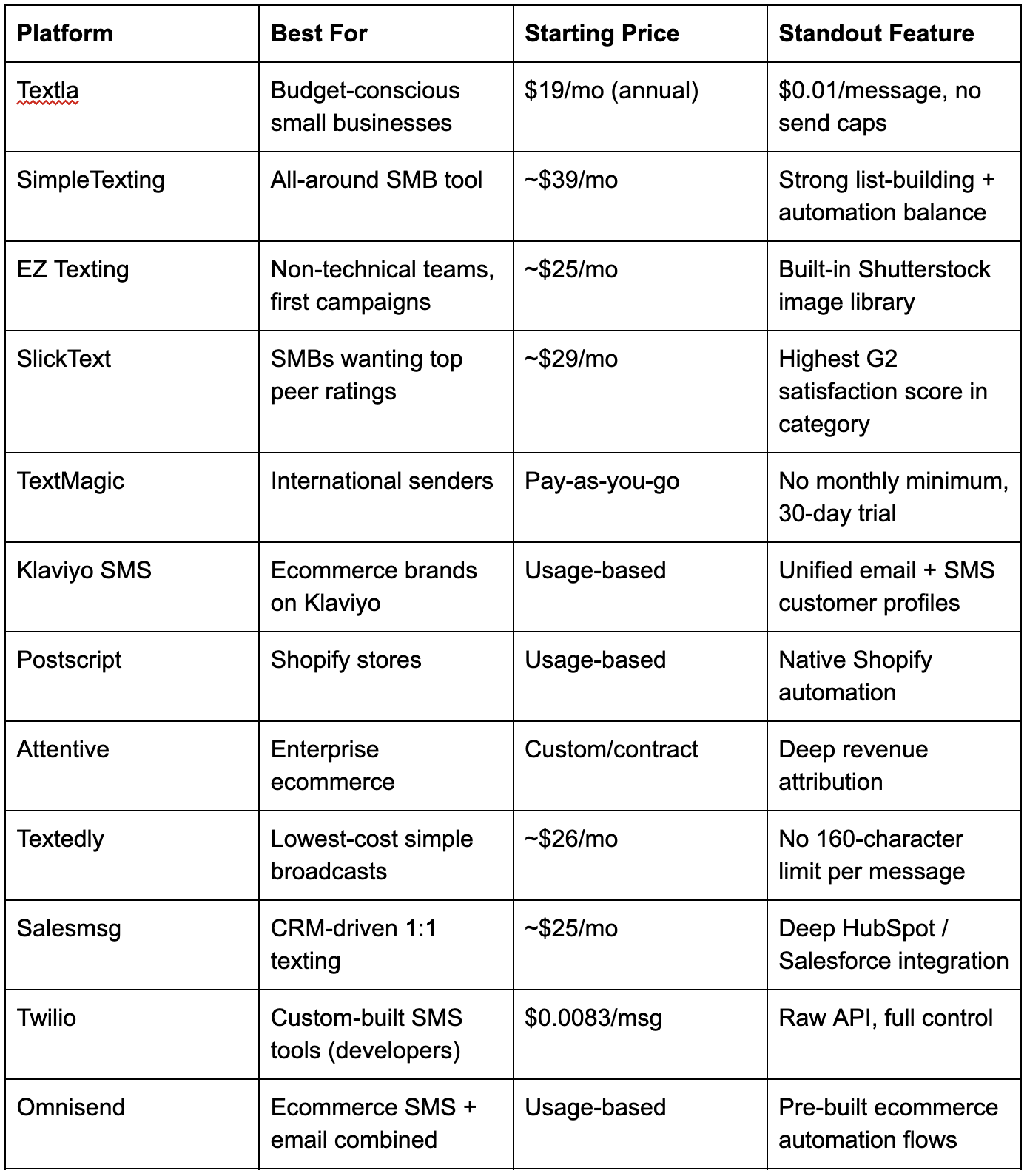
Full platform reviews
1. Textla
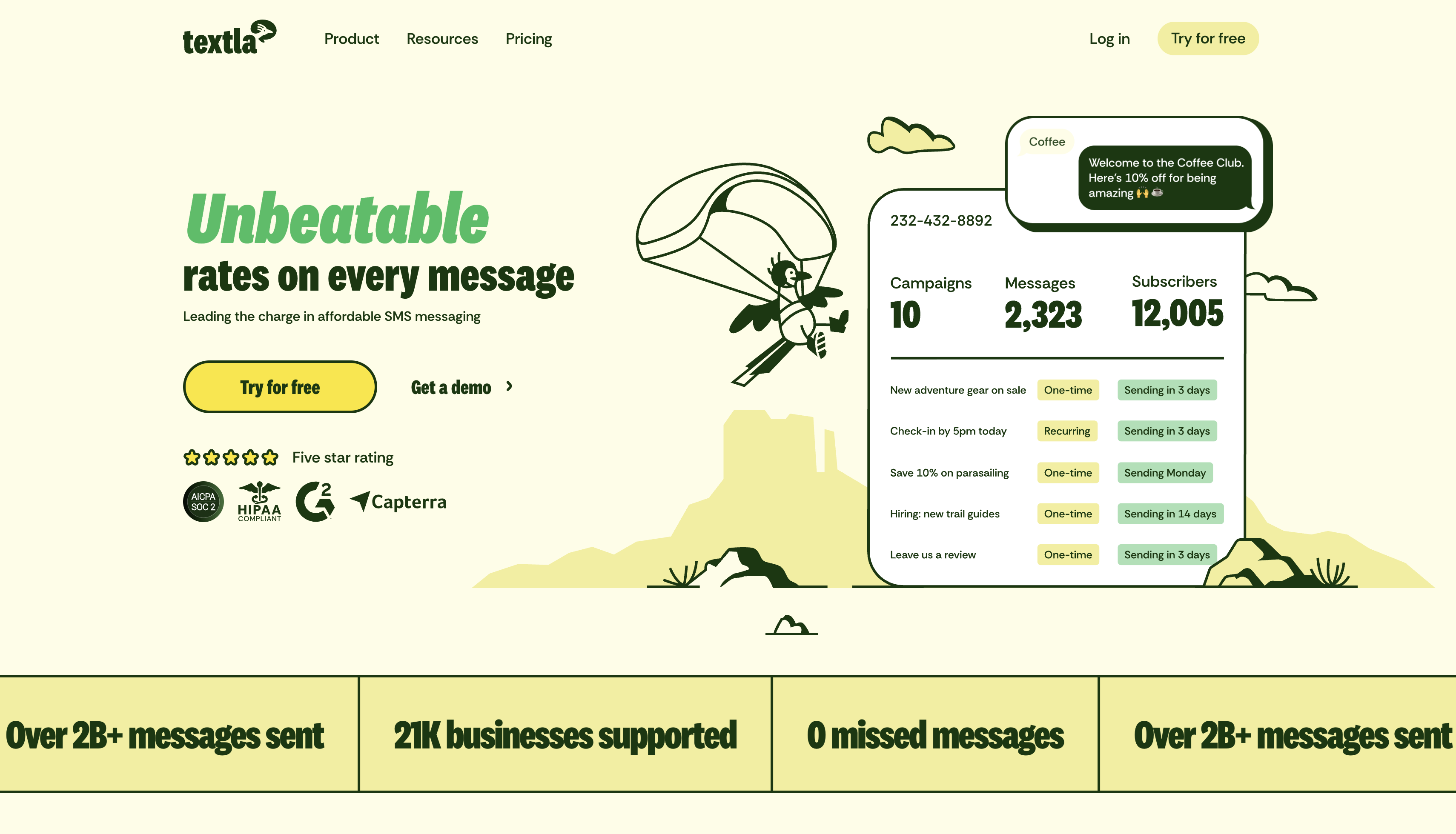
Best for: Small businesses that want core SMS marketing tools without enterprise pricing.
Textla is a straightforward bulk-texting and two-way messaging platform aimed squarely at small businesses. Roughly 96% of its reviewer base falls into the SMB category, concentrated in marketing and advertising, retail, and financial services. Core features include mass campaigns, scheduled sends, automation, audience segmentation, contact management with automatic invalid-number cleanup, and delivery reporting. It integrates with Twilio for message delivery infrastructure and Zapier for broader app connectivity.
Pricing is transparent and sits toward the lower end of the category. The Starter plan runs $19/month billed annually ($25/month billed monthly), and Professional runs $39/month annually ($50/month monthly), with per-message rates around $0.01 for US SMS and $0.03 for MMS on top of the base plan. There are no hidden number-registration or activation fees layered on, and a free trial is available. For a deeper breakdown of how these costs compare across the category, see Textla's guide to SMS marketing costs.
Pros:
- Transparent, published pricing with no forced number-registration or activation add-ons
- Among the lowest per-message rates of any marketing-focused platform that isn't raw API infrastructure
- Automatic contact list cleanup (invalid number removal) built in
- In head-to-head G2 comparisons against similarly-priced competitors, Textla reviewers report high marks on ease of setup and quality of support
Cons:
- Intentionally scoped for SMB use. It doesn't offer the advanced ecommerce automation, deep native integration catalog, or enterprise reporting that Klaviyo, Attentive, or Postscript provide.
- Smaller independent review sample size than more established players like SlickText or Textedly, which makes benchmark comparisons somewhat less statistically robust
- Best suited to businesses that want core texting done well rather than an all-in-one marketing suite
2. SimpleTexting
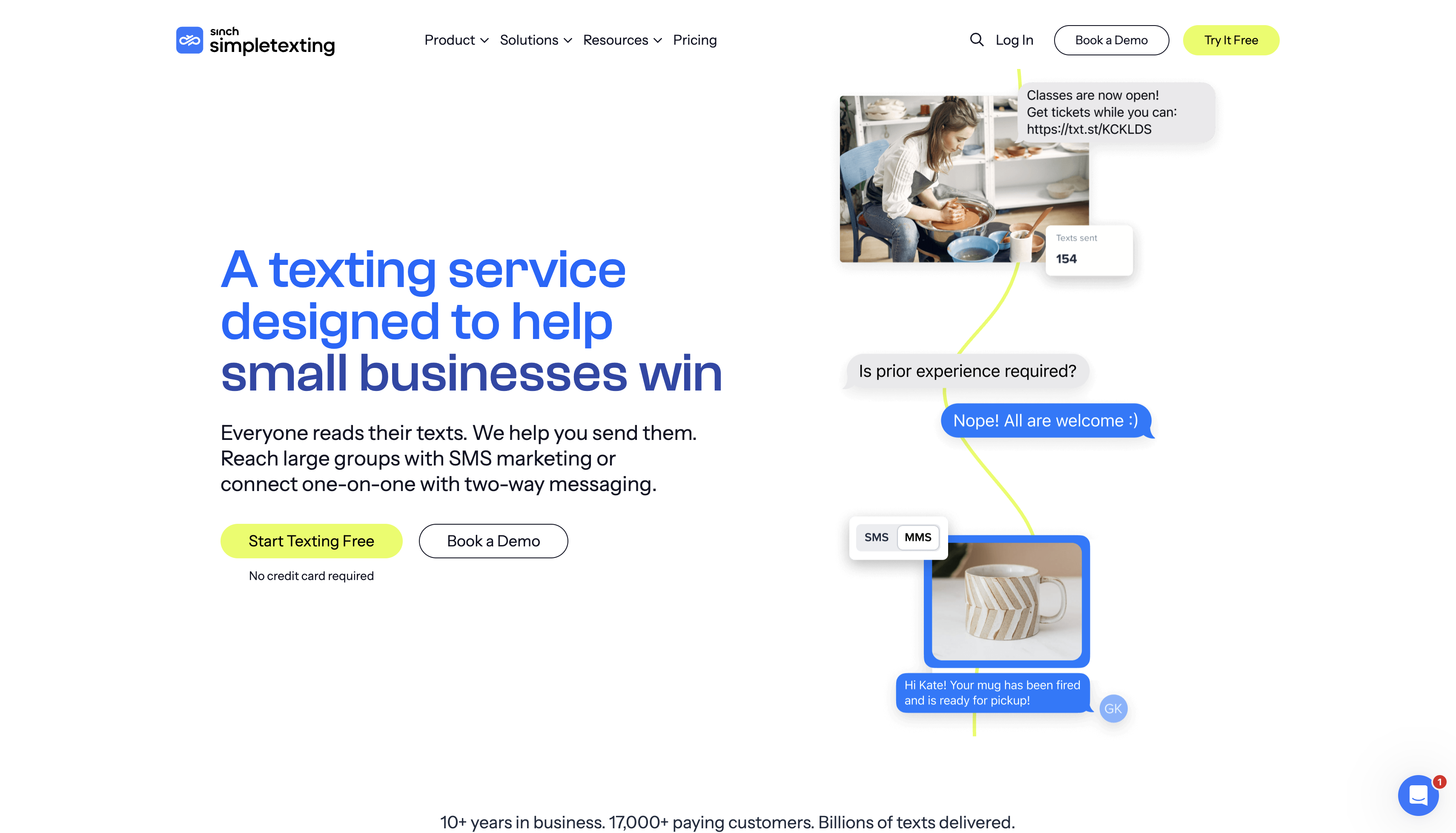
Best for: Small to midsize businesses wanting a balanced, no-frills marketing tool.
SimpleTexting covers the fundamentals well: two-way messaging, MMS, segmentation, and integrations with Mailchimp, HubSpot, and Zapier. Automation flows are solid without being overwhelming.
Pros:
- Clean, approachable campaign builder
- Solid segmentation and list-growth tools (web forms, QR codes, keywords)
- Responsive customer support, widely praised in reviews
Cons:
- A $4 activation fee plus a $10/month local number registration fee stack on top of plan pricing
- Automation is less sophisticated than ecommerce-native tools like Klaviyo or Postscript
3. EZ Texting
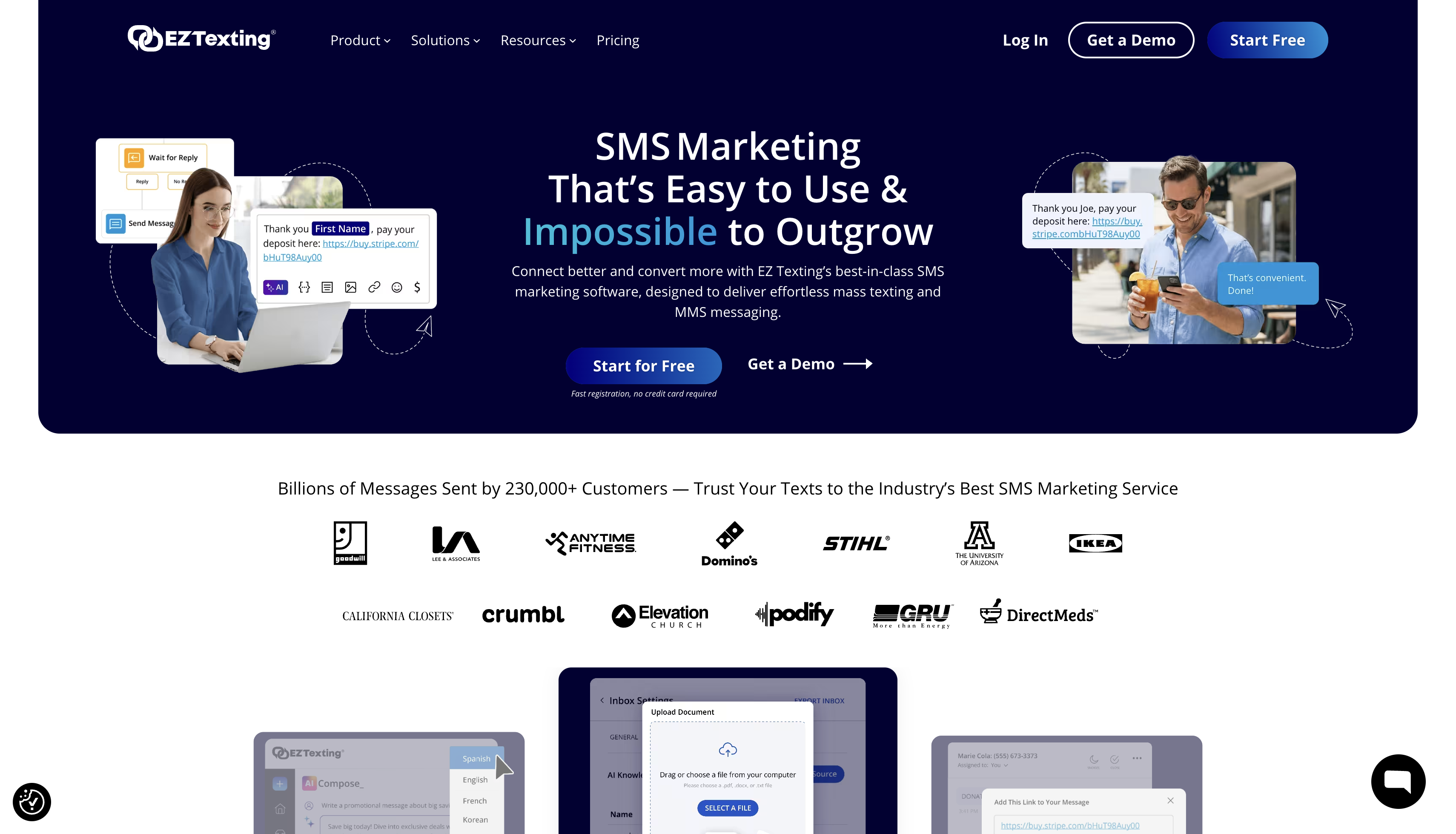
Best for: Non-technical teams launching their first campaigns.
EZ Texting's biggest differentiator is a native Shutterstock integration, with 20 million stock photos built into the campaign builder, plus AI-assisted message drafting and QR code generation for offline-to-online campaigns.
Pros:
- Guided onboarding designed for first-time SMS senders
- Unlimited keywords and a dedicated 10-digit long code included on most plans
- Free incoming messages, a benefit often gated behind higher tiers elsewhere
Cons:
- Upgrading tiers can multiply your bill without proportionally increasing included message credits. Verify the actual credit allowance before upgrading, not just the plan name.
- Less suited to high-volume programs than SlickText or SimpleTexting on a per-message cost basis
4. SlickText
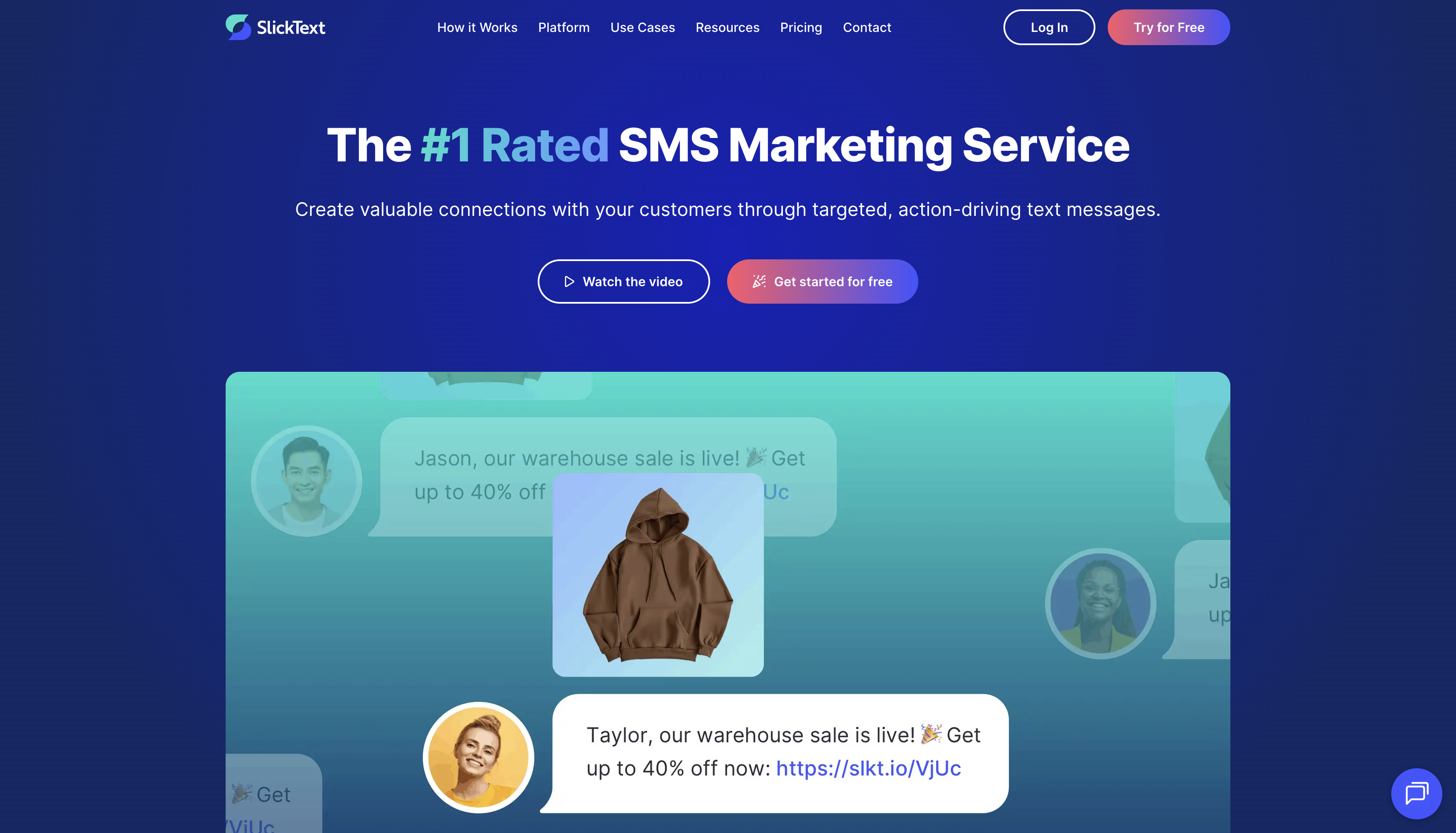
Best for: SMBs that weight peer reviews heavily in their decision.
SlickText holds one of the highest satisfaction ratings on G2 among mainstream SMS platforms, around 4.8/5, with pricing starting near $29/month. It covers automation, two-way messaging, and compliance tooling without a steep learning curve.
Pros:
- Consistently strong independent review scores across ease of use, support, and setup
- Solid compliance tooling for opt-in/opt-out management
- Straightforward pricing tiers
Cons:
- Fewer native ecommerce-specific automations than Klaviyo, Postscript, or Omnisend
- Less name recognition among enterprise buyers than Attentive or Klaviyo
5. TextMagic
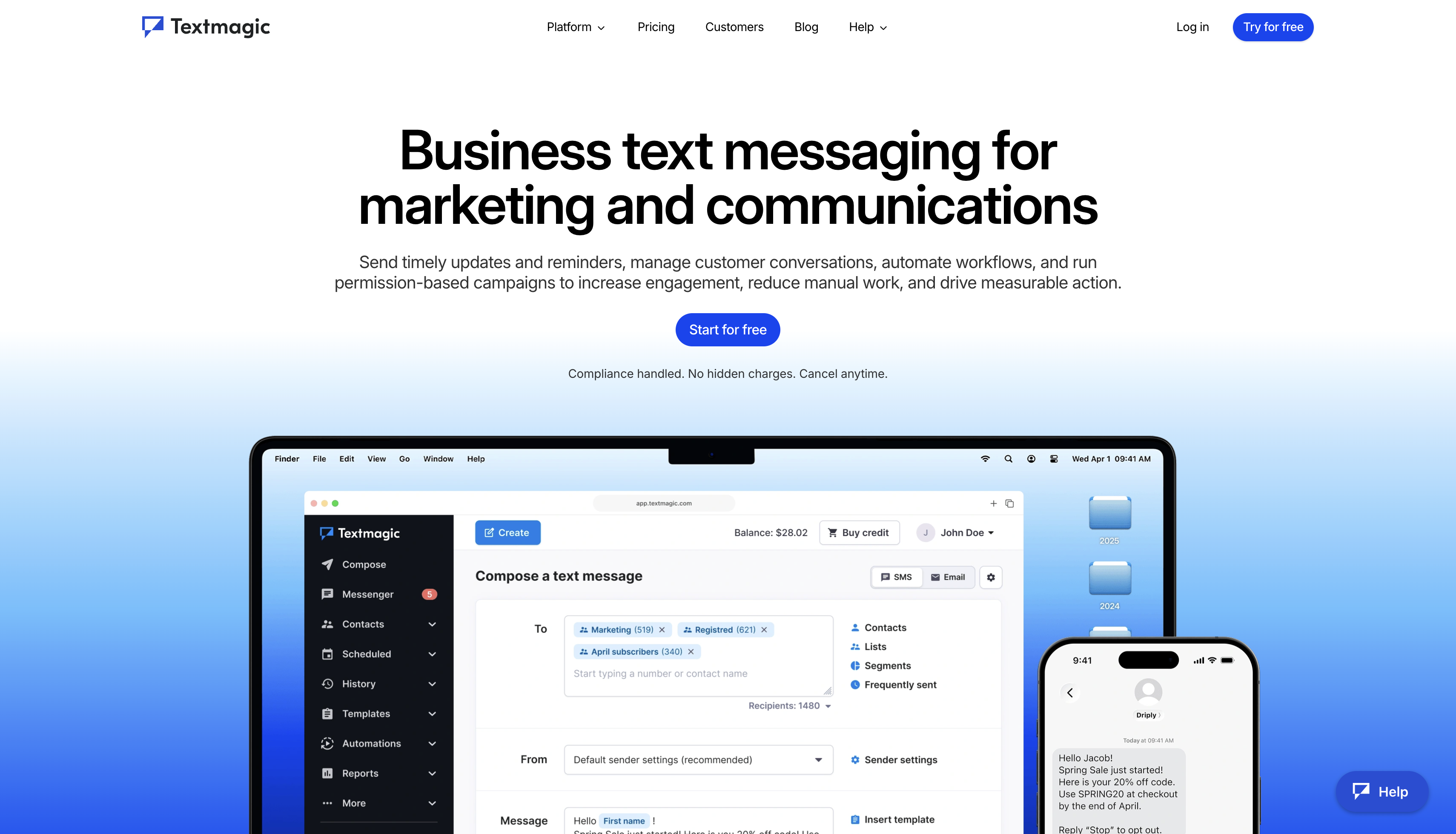
Best for: Businesses that text internationally or want to avoid monthly commitments.
TextMagic runs on a pay-as-you-go model with no forced monthly minimum, plus a 30-day free trial, one of the longest in the category.
Pros:
- No monthly commitment. You pay for what you send.
- Strong international coverage and rates for cross-border texting
- Long free trial period relative to competitors
Cons:
- Marketing automation is thinner than on dedicated marketing platforms; it leans more toward transactional and operational texting
- Interface feels more utilitarian than marketing-focused competitors
6. Klaviyo SMS
Best for: Ecommerce brands that already run Klaviyo for email.
Klaviyo unifies SMS with email under one customer profile, so a single behavioral trigger (cart abandonment, purchase, browse abandonment) can fire both channels using the same data and the same automation builder.
Pros:
- Unified customer data across email and SMS, not two tools bolted together
- Strong benchmark data and reporting depth
- AI-assisted send-time and content optimization
Cons:
- Weak value proposition as a standalone SMS tool if you're not already using Klaviyo for email
- Pricing scales with contact and send volume and can get expensive at scale
7. Postscript
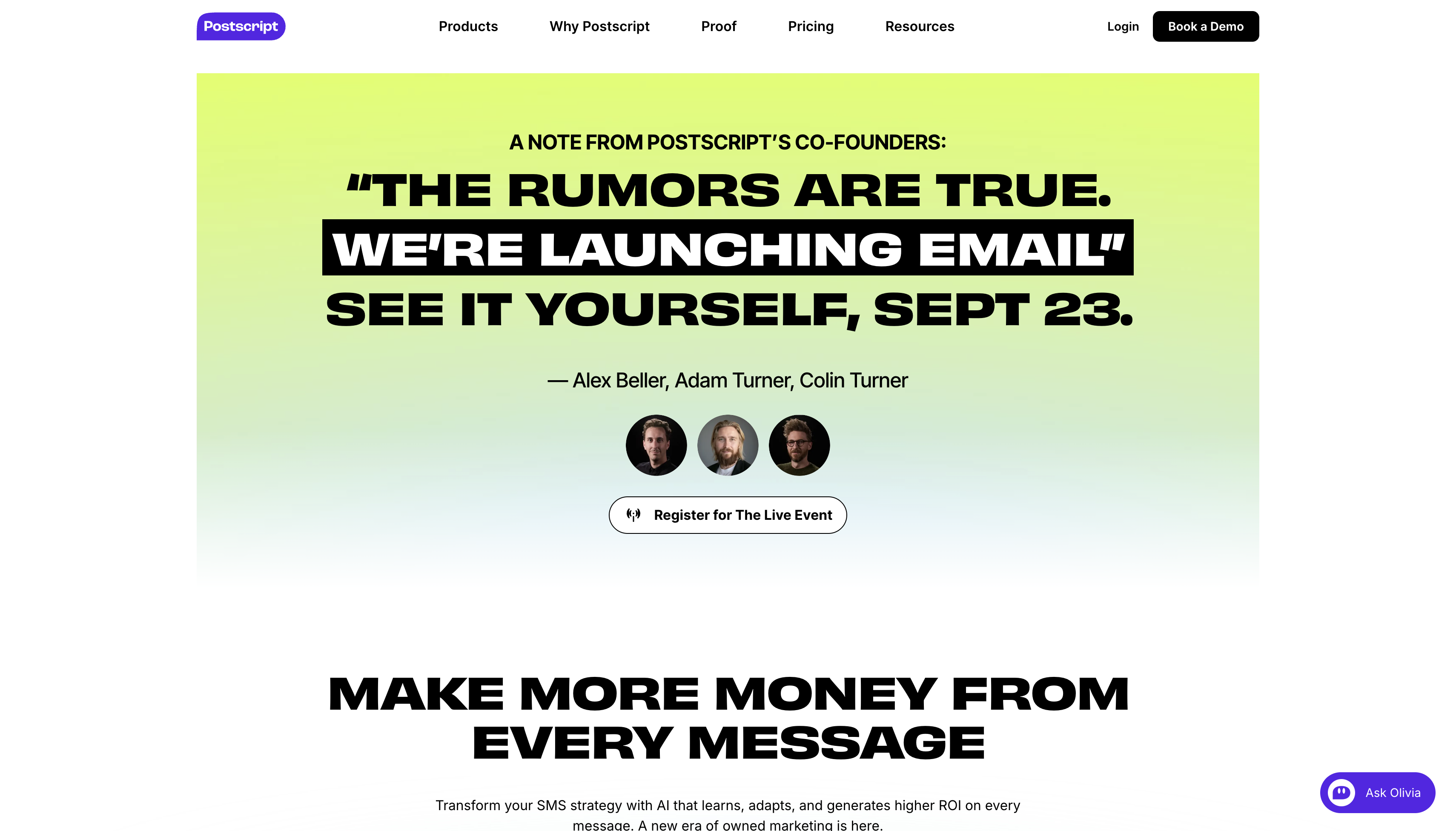
Best for: Shopify-native stores.
Postscript plugs directly into Shopify order and customer data, making cart-recovery and post-purchase flows fast to set up without custom integration work.
Pros:
- Deep, purpose-built Shopify integration
- Pre-built ecommerce automation templates for abandoned cart, win-back, and post-purchase flows
- Strong compliance and consent management for the Shopify checkout flow
Cons:
- Limited usefulness outside Shopify; not a fit for non-ecommerce or non-Shopify businesses
- Usage-based pricing can be harder to predict than flat-fee competitors
8. Attentive
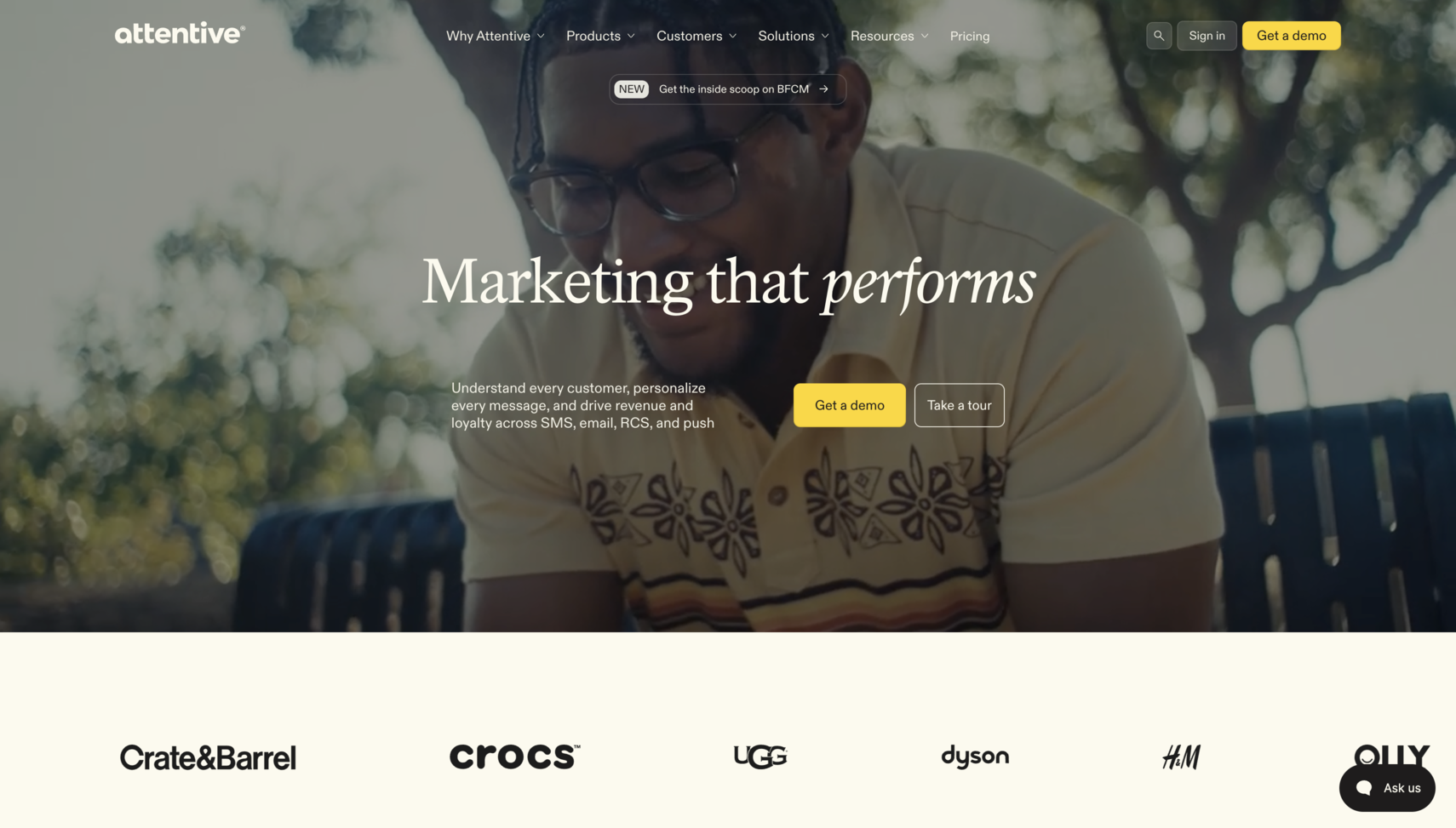
Best for: Enterprise ecommerce brands with dedicated marketing ops teams.
Attentive is built for scale, with deep revenue attribution, AI-assisted send-time optimization, and enterprise-grade support.
Pros:
- Best-in-class revenue attribution and reporting for large-scale programs
- Dedicated account and strategy support for enterprise customers
- AI-driven optimization tools that are mature relative to competitors
Cons:
- Custom and contract pricing, with no published rates, makes it harder to comparison-shop
- Multiple independent reports describe contracts with multi-month commitments and exclusive-SMS clauses that make switching providers difficult. Get all terms in writing and reviewed before signing.
- Overkill, and overpriced, for SMB-scale sending
9. Textedly
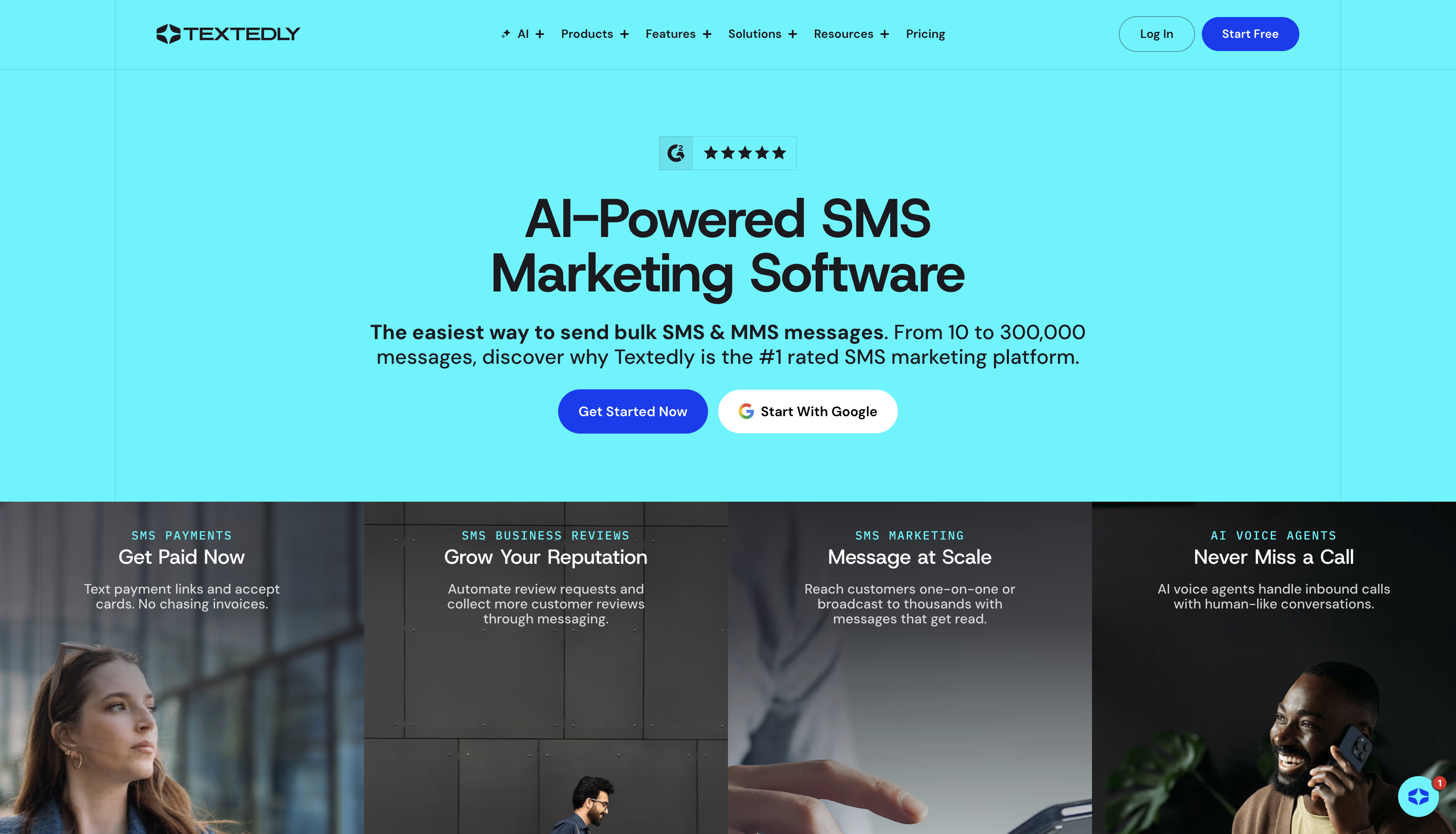
Best for: Simple, low-cost broadcast messaging.
Textedly's main edge is character limits. It doesn't cap messages at 160 characters the way some competitors do, so longer broadcasts don't get split into confusing multi-part texts.
Pros:
- No hard character limit on messages
- Straightforward, budget-friendly pricing for broadcast-style sending
- Large, well-established review base (1,000+ on G2) with generally solid satisfaction scores
Cons:
- Automation and segmentation are more basic than on marketing-first platforms
- Less suited to complex, behavior-triggered campaigns
10. Salesmsg
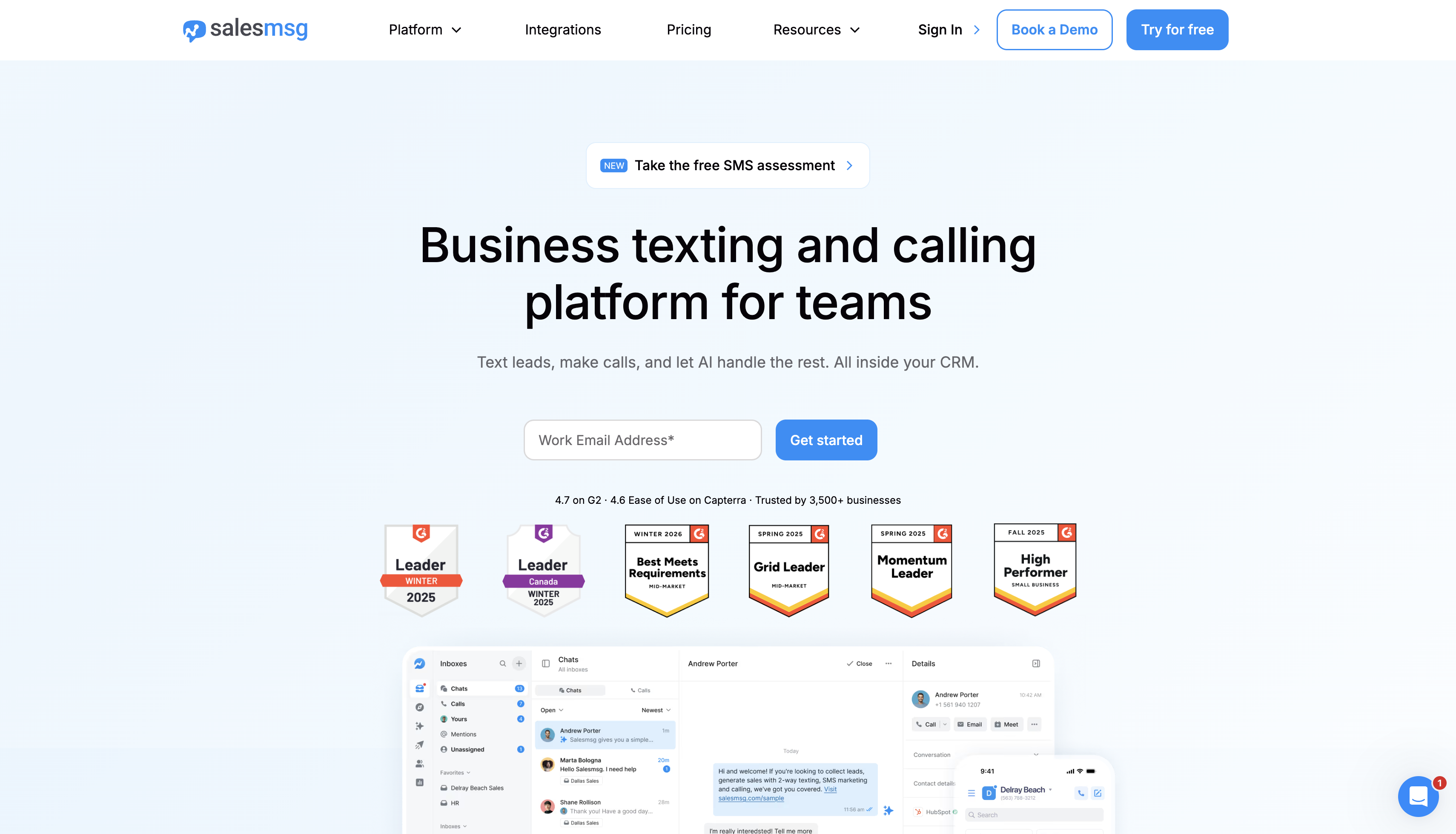
Best for: Sales and support teams texting from CRM records.
Salesmsg is built around 1:1 conversational texting tied to CRM data (HubSpot, Salesforce, Pipedrive), making it a better fit for reps managing individual relationships than for blast marketing campaigns.
Pros:
- Deep, well-regarded CRM integrations
- Strong for shared-inbox and team texting workflows
- Published compliance benchmark research (Salesmsg's own State of SMS report) offers unusual transparency about industry-wide 10DLC rejection causes
Cons:
- Not built for large-scale broadcast marketing campaigns
- Less relevant if your primary use case is promotional blasts rather than 1:1 conversations
11. Twilio
Best for: Developers building a fully custom SMS tool.
Twilio is raw messaging infrastructure, not a marketing platform. At roughly $0.0083 per US message, it's the cheapest per-send rate in this comparison, but there's no campaign builder, contact management, or templates out of the box.
Pros:
- Lowest raw per-message cost in this comparison
- Full programmatic control to build exactly the workflow you need
- Powers the backend of several other platforms on this list, so it's proven infrastructure at scale
Cons:
- Requires developer resources; there's no usable marketing interface out of the box
- You own compliance and 10DLC registration and consent-tracking implementation yourself unless you build or buy that layer separately
12. Omnisend
Best for: Ecommerce brands wanting SMS and email in pre-built automation workflows.
Omnisend ships with ready-made ecommerce flows for abandoned cart, welcome series, and order confirmation, spanning both email and SMS, which shortens setup time for online stores that don't want to build automations from scratch.
Pros:
- Strong pre-built automation library specifically for ecommerce
- Combined email and SMS reporting in one dashboard
- Competitive pricing relative to Klaviyo for similar functionality
Cons:
- Less mature SMS-specific feature depth than SMS-first platforms
- Best value comes from using both email and SMS together, not SMS alone
Compliance: 10DLC, TCPA, and consent in 2026
This is the part of platform selection most comparison articles skip, and it's arguably more important than any feature comparison, because non-compliance can shut down your sending entirely or expose you to real financial liability.
10DLC registration is mandatory, not optional. Since February 1, 2025, US carriers block unregistered Application-to-Person (A2P) 10DLC traffic outright rather than just filtering it. If your business uses software to send recurring or automated marketing texts from a local US number, you need brand- and campaign-level registration through The Campaign Registry (TCR), regardless of company size or message volume. Typical approval timelines run 1-3 business days for brand registration and 2-7 business days for campaign registration. A few industries, including cannabis, firearms, payday loans, and debt relief, are categorically ineligible for standard 10DLC registration.
TCPA governs consent, independent of carrier rules. The Telephone Consumer Protection Act requires prior express written consent before sending marketing texts. Pre-checked boxes don't count, and the consent language must disclose that texts will be sent, roughly how often, and that message and data rates may apply. Violations carry fines of $500 per message, rising to $1,500 for willful violations, with no cap on aggregate damages, which is why even modest-scale non-compliant campaigns can carry significant theoretical exposure. TCPA class-action filings have risen sharply through 2025 and into 2026 according to multiple legal-tracking sources. This is a live litigation risk, not a theoretical one. The FCC's Enforcement Bureau treats unwanted robotexts as one of its top consumer-complaint priorities.
The FCC's "one-to-one consent" rule status is genuinely unsettled. A proposed federal rule would have required businesses to collect their own separate consent rather than relying on shared lead-generation forms. That rule was vacated by the 11th Circuit (reported as either late 2024 or January 2025 depending on the source), so there is currently no live federal one-to-one consent requirement in force. Carriers and TCR reviewers have moved toward one-to-one consent expectations on their own initiative regardless, and plaintiffs' attorneys continue litigating consent quality under existing TCPA law. The practical guidance is to document consent per brand no matter where the federal rule stands. The safest assumption is that shared or purchased lead lists are a liability, not a shortcut.
Other rules that trip businesses up:
- Quiet hours: No marketing texts before 8 AM or after 9 PM in the recipient's local time zone.
- Opt-out handling: STOP, UNSUBSCRIBE, and QUIT must all work, and opt-outs must be honored immediately across every tool touching that contact, not just your broadcast platform. A CRM workflow that keeps texting someone who opted out of your marketing list is still a violation.
- SHAFT content restrictions: Sex, Hate, Alcohol, Firearms, and Tobacco-related content is prohibited or heavily restricted under the CTIA Messaging Principles and Best Practices, regardless of consent status.
- Consent documentation: You need to be able to prove consent was given, not just claim it was.
What this means for platform choice: the best platforms handle 10DLC registration support, opt-out propagation, and quiet-hours enforcement in the background. Platforms that leave this entirely to you, like raw Twilio, require you to build or buy that compliance layer separately. Factor that into any "cheapest option" comparison, since the cost of a compliance gap can dwarf any per-message savings.
This section is for general informational purposes and isn't legal advice. Consult qualified counsel for guidance specific to your business and the states you operate in.
13. Maestra
Best for: Ecommerce brands that want behavior-based SMS set up for them.
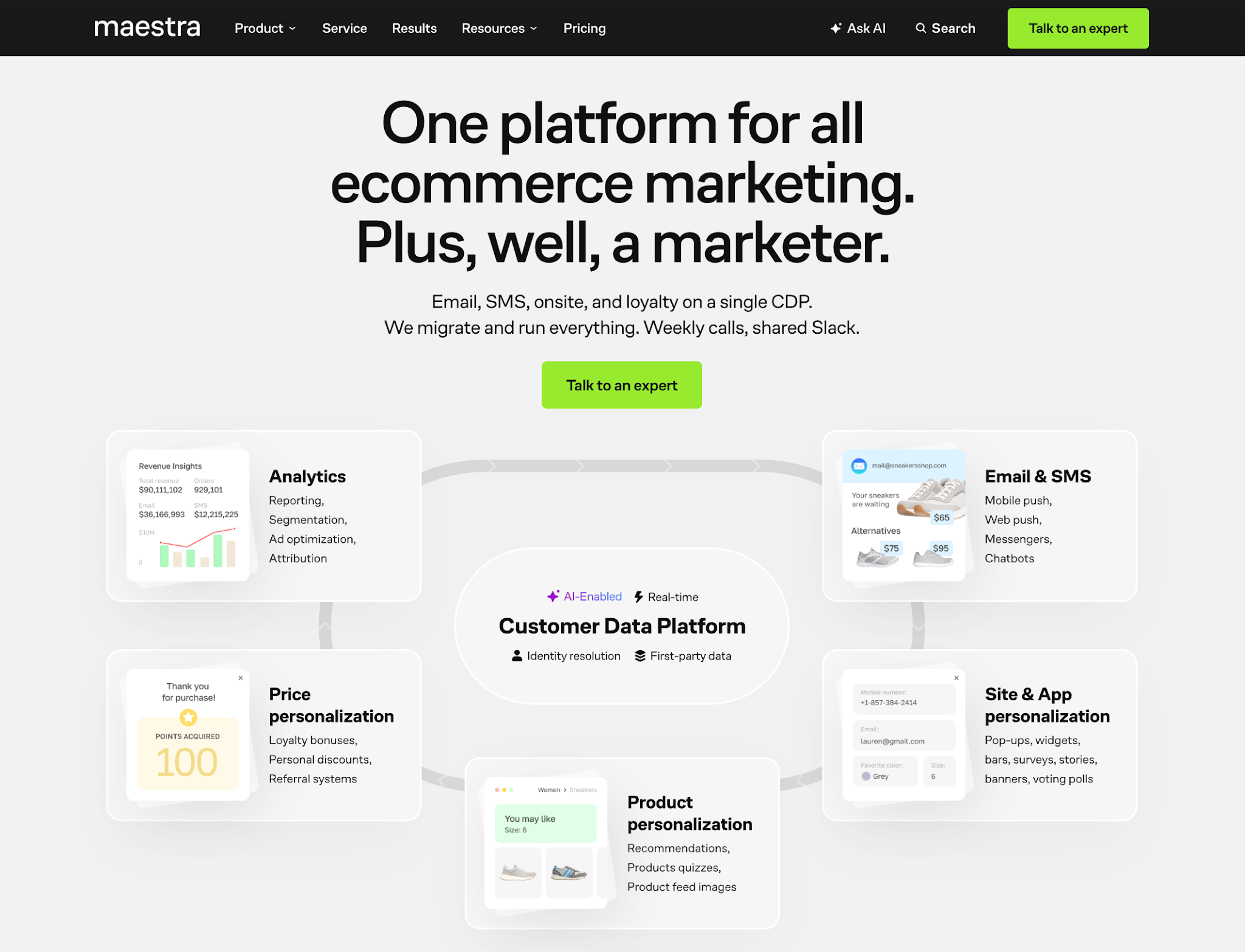
Maestra sends SMS, MMS, and RCS from the same flows that can also send your email and push. Those automations respond to what a shopper does or stops doing, whether that's a product they looked at or 60 days without an order. Your Forward Deployed Marketer sets up those flows and keeps tuning them, at no extra cost.
Pros:
- One SMS can pair a sale at the shopper's nearest store with the loyalty points they can spend
- Multi-step flows for time-sensitive moments, like price drops, over SMS, MMS, and RCS
- A named Forward Deployed Marketer works in your Slack, on your team's hours
Cons:
- No free plan or trial
- Built for mid-market and enterprise ecommerce rather than local service businesses
SMS vs. email marketing
Neither channel replaces the other. They serve different jobs.
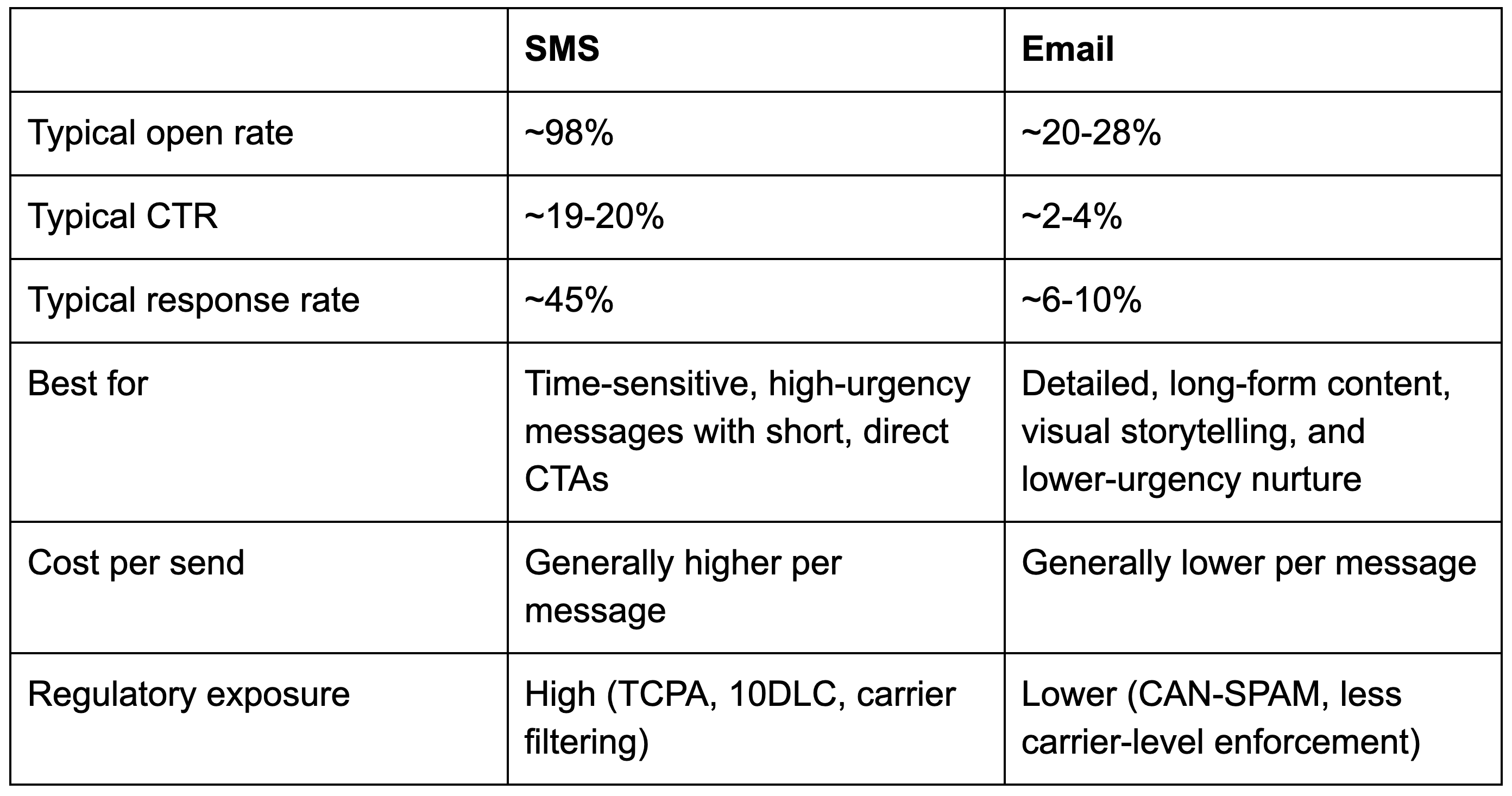
In practice, most ecommerce and retail brands run both, using platforms like Klaviyo or Omnisend that unify the two channels around shared customer data rather than treating them as separate systems.
Number types explained
Every SMS platform sends from one of three number types, and the choice affects cost, throughput, and setup time:
- 10-digit long code (10DLC): A standard-looking phone number. Cheaper and good for conversational, two-way texting, but lower message throughput (messages per second) than short codes. Most SMB platforms, including Textla, EZ Texting, and SimpleTexting, default to long codes.
- Short code: A 5-6 digit number (like 12345). High throughput, built for large-volume blasts, but costs more and typically takes longer to provision and register, often several weeks.
- Toll-free number: Sits in the middle, with better throughput than a long code and faster provisioning than a short code, at a moderate cost. A common choice for growing SMB and mid-market senders.
How to choose, by business type
Solo or small local business (salon, restaurant, contractor): You need appointment reminders and occasional promotions, not enterprise automation. Textla, Textedly, or EZ Texting cover this without paying for unused features.
Growing SMB running regular promotional campaigns: SlickText or SimpleTexting balance automation depth with approachability.
Shopify ecommerce store: Postscript's native integration saves setup time other platforms can't match.
Ecommerce brand already using Klaviyo for email: Klaviyo SMS, for the unified customer data model. That's a genuinely different value proposition than a standalone tool.
Large-scale ecommerce with a dedicated marketing ops team: Attentive, but negotiate contract terms carefully before signing.
Sales or support team texting from CRM records: Salesmsg, built specifically for 1:1 conversational texting tied to CRM data.
International sender or unpredictable volume: TextMagic's pay-as-you-go model avoids a monthly floor.
Developer team building a custom product: Twilio's raw API, with the understanding that you're building the marketing and compliance layer yourself.
Mid-market or enterprise ecommerce brand with a lean marketing team: Maestra, where a Forward Deployed Marketer does the heavy lifting at no extra cost.
Common mistakes to avoid
- Buying or renting a shared lead list. Even with no federal one-to-one consent rule currently in force, carriers and plaintiffs' attorneys increasingly treat shared-consent lists as a liability. Build your list through your own opt-in flows.
- Ignoring the total cost, not just the sticker price. Number registration fees, activation charges, and overage rates can turn a "cheap" plan into the most expensive option once you account for real usage.
- Letting opt-outs live in only one system. If a contact opts out of your broadcast platform but stays active in a separate CRM automation, you're still violating TCPA when that automation fires.
- Sending outside quiet hours. 8 AM to 9 PM recipient local time isn't a suggestion. It's a compliance requirement, and time-zone handling should be automatic in whatever platform you choose.
- Treating SMS like email. Long, multi-paragraph promotional copy performs worse than short, direct, single-CTA messages. The channel rewards brevity.
- Skipping 10DLC registration because "we're too small to matter." Registration requirements are based on whether messages are application-triggered, not on company size or volume. Carriers block unregistered traffic regardless of how small the sender is.
Glossary
- A2P (Application-to-Person): Automated messages sent from a business's software to a consumer's phone. This is the category that requires 10DLC registration.
- P2P (Person-to-Person): Genuine one-on-one texting between two individuals using personal phones, not subject to the same registration requirements.
- 10DLC: 10-Digit Long Code, a standard local phone number registered for A2P business messaging.
- TCR (The Campaign Registry): The industry body that manages 10DLC brand and campaign registration.
- TCPA: Telephone Consumer Protection Act, the federal law governing consent for marketing texts and calls.
- SHAFT: Content category restrictions (Sex, Hate, Alcohol, Firearms, Tobacco) enforced by carriers regardless of consent.
- MMS: Multimedia Messaging Service, texts that include images, GIFs, or video, as opposed to plain-text SMS.
- Throughput: The number of messages a sending number can deliver per second, a key differentiator between long codes, toll-free numbers, and short codes.
Frequently asked questions
Is SMS marketing still effective in 2026? Yes. SMS open rates remain far higher than email, commonly cited around 98%, largely because text is a channel people check almost immediately after receiving a message.
Do I need a business texting platform, or can I just use my phone? Beyond a handful of contacts, yes. Personal phones aren't built for bulk sending, get flagged as spam by carriers at volume, and don't handle the opt-in/opt-out tracking and 10DLC registration that compliance now requires.
What's the difference between a 10-digit long code, short code, and toll-free number? See the Number types explained section above. In short, long codes are cheaper but lower-throughput, short codes are built for high-volume blasts but cost more and take longer to set up, and toll-free numbers sit in between.
How much does SMS marketing typically cost? Entry-level platforms start around $19-$40/month for a base subscription, plus per-message costs typically ranging from $0.01 to $0.05 per SMS domestically. International rates run considerably higher, often $0.25-$0.50 per message.
Which platform is cheapest for a small business just starting out? Among platforms with published, no-minimum pricing, Textla ($19/month annual, $0.01/message) and Textedly sit at the lower end for SMB budgets, while TextMagic's pay-as-you-go model avoids a monthly commitment entirely.
Do I really need 10DLC registration if I'm a small business? Yes. Registration requirements are based on whether your texts are application-triggered (A2P), not on company size or message volume. Since February 2025, carriers block unregistered A2P traffic entirely regardless of how small the sender is.
What happens if I violate TCPA? Fines run $500 per message, rising to $1,500 for willful violations, with no cap on total damages across a campaign, which is why even a single non-compliant send to a sizeable list carries real financial exposure. TCPA class-action filings have increased significantly through 2025 and into 2026.
Can I text customers who haven't explicitly opted in? No. TCPA requires prior express written consent before marketing texts, and that consent can't be a pre-checked box. It needs to clearly disclose that texts will be sent, roughly how often, and that message and data rates may apply.
.webp)